Jaden Zhang
Robotics/Tensegrity Research
Summer Undergraduate Research at CLIMB Lab
The CLIMB lab, formerly the RIS lab from Hong Kong, has recently moved to the University of Toronto, and so, I took the chance to emmerse myself in a research-focused environment for the summer of 2026. With the lab's focus on multimodel (terrestrial/aerial mainly), the hopcopter platform was the main building blocks of most of our projects. Going into the summer, the goal was to investigate the possibility of implementing tensegrity principles and structures to increase the efficiency/robustness of the base hopcopter.
The Hopcopter is a hybrid robotic platform designed to overcome the strict endurance limits of standard fully aerial drone by utilizing passive terrestrial hopping to minimize energy-intensive thruster usage. To optimize its landing and rebound mechanics, this project integrated tensegrity—a lightweight structural system stabilized entirely by a continuous network of members purely in axial compression or tension. This unique layout diffuses loads to prevent localized weak points and offers an exceptionally high strength-to-weight ratio, amd making it ideal for safely absorbing high-G landing impacts from any orientation.
Through the summer, my main focus was the development of a Matlab physics engine to simulate the movements and efficiency of Class-1 tensegrity structures, as well as a brief building of a final conceptual design validated through the simulation. Worked under Prof. Pakpong Chirarattananon
May 2026 - August 2026
Key Skills: Theoretical design, physics simulator building, Matlab, vector based kinematics/dynamics.
Matlab Tensegrity Physics Engine
To quantitatively evaluate tensegrity structures for a hybrid aerial-terrestrial robot, a custom physics engine was developed in MATLAB to simulate complex internal forces, structural stiffness, and rebound efficiency. Evaluating these metrics was critical because tensegrity impact dynamics are stiff, non-linear, and mathematically chaotic, making standard rigid-body simulations inadequate.
The engine was designed to handle form finding by discovering equilibrium layouts from initial strut coordinates, as well as simulating dynamic drop tests and vectorized ground collisions. This allowed for the virtual prototyping of structural responses before committing to time-intensive physical builds.
- Developed a 4th-Order Runge-Kutta (RK4) numerical integration scheme in MATLAB, utilizing a microsecond time step to successfully stabilize high-stiffness spring calculations without high explicit Euler integration error accumulation
- Modeled viscoelastic material hysteresis in elastomers (as tendons) using Hooke's Law combined with a viscous damper to accurately simulate energy lost to heat during rapid load-cycles
- Implemented a mass-scaled spring-damper penalty model for ground collisions, ensuring stability and continuous contact constraints without causing high-frequency integration blow-ups when landing is detected.
- Developed a "Ghost Leg" abstraction to benchmark 1-DOF telescoping leg dynamics against the 3D multi-body tensegrity framework, isolating tangential velocity to model linear bearing binding under lateral shear
- Logged kinetic and potential energy states to isolate translational kinetic energy from parasitic rotational spin, producing a pure performance metric of structural hopping efficiency
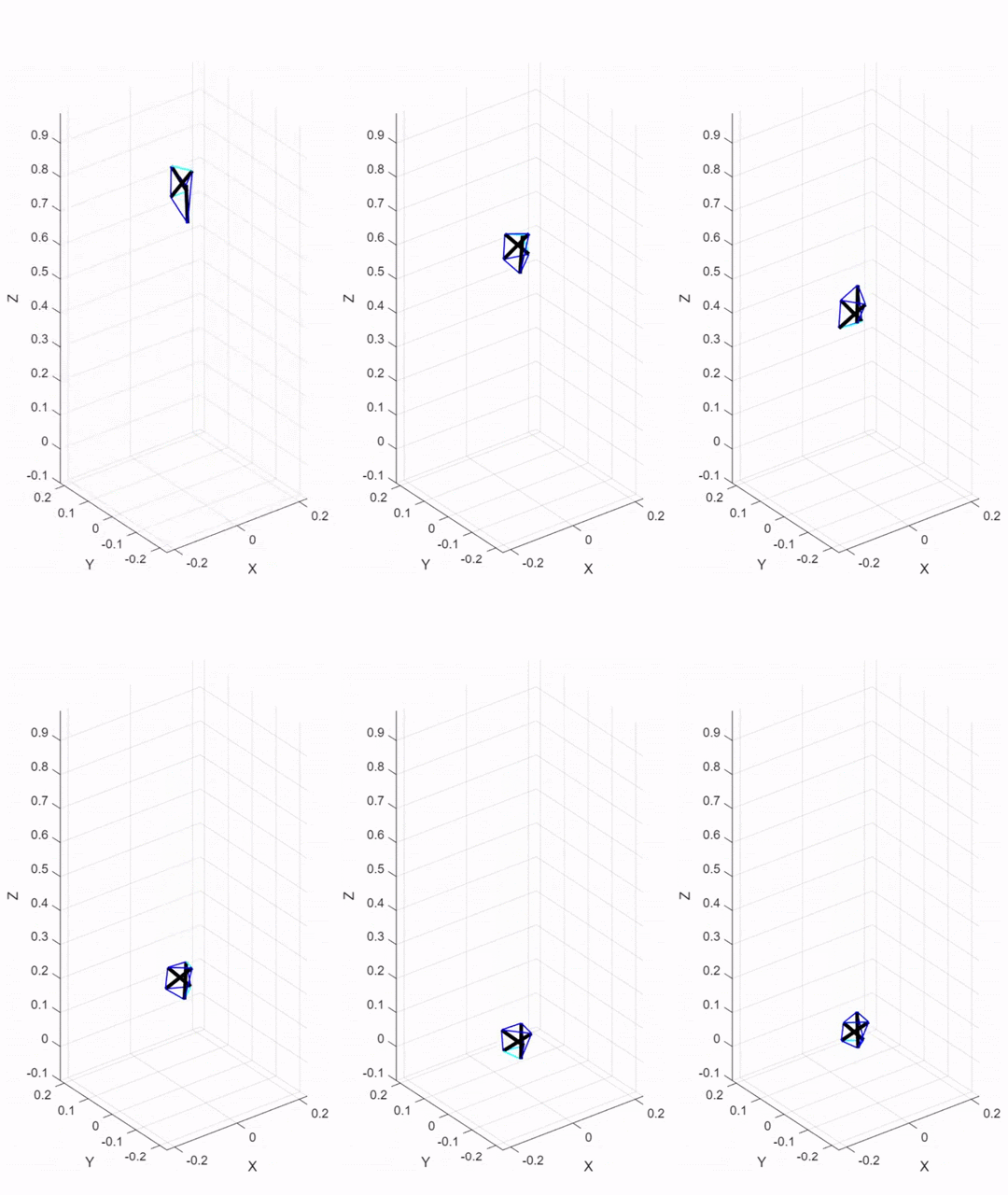
Visualization of a sim. Note that it form finds (comes to equilibirum) halfway through the fall, and then collides with the ground accordingly. Black are rigid members solely in compression, blue are cable/elastomer members purely in tension.
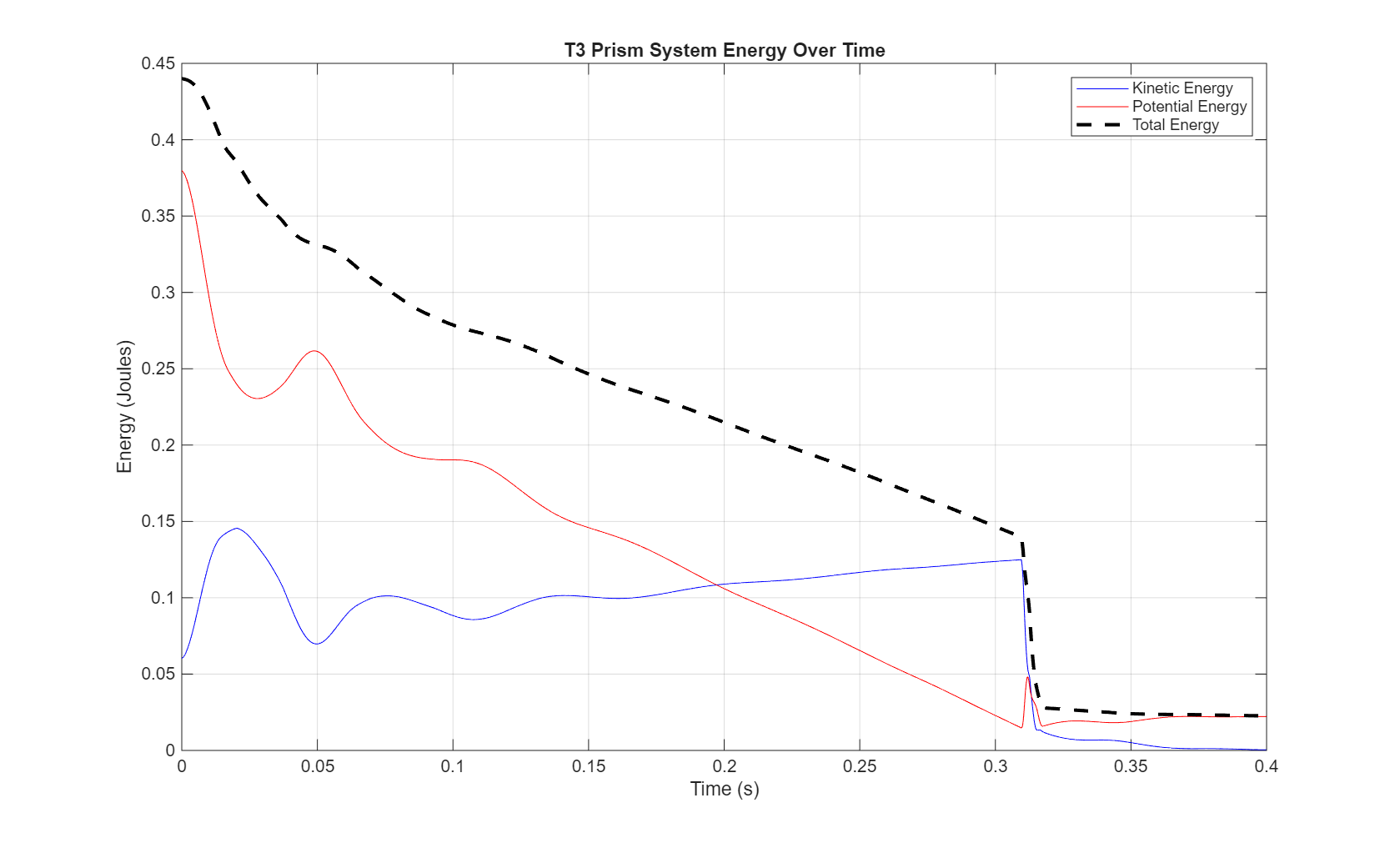
The accompanying energy plot that corresponds to the previous slide's simulation. Note that the total energy decreases over time due to hystersis, then drops significantly after colliding with the ground.
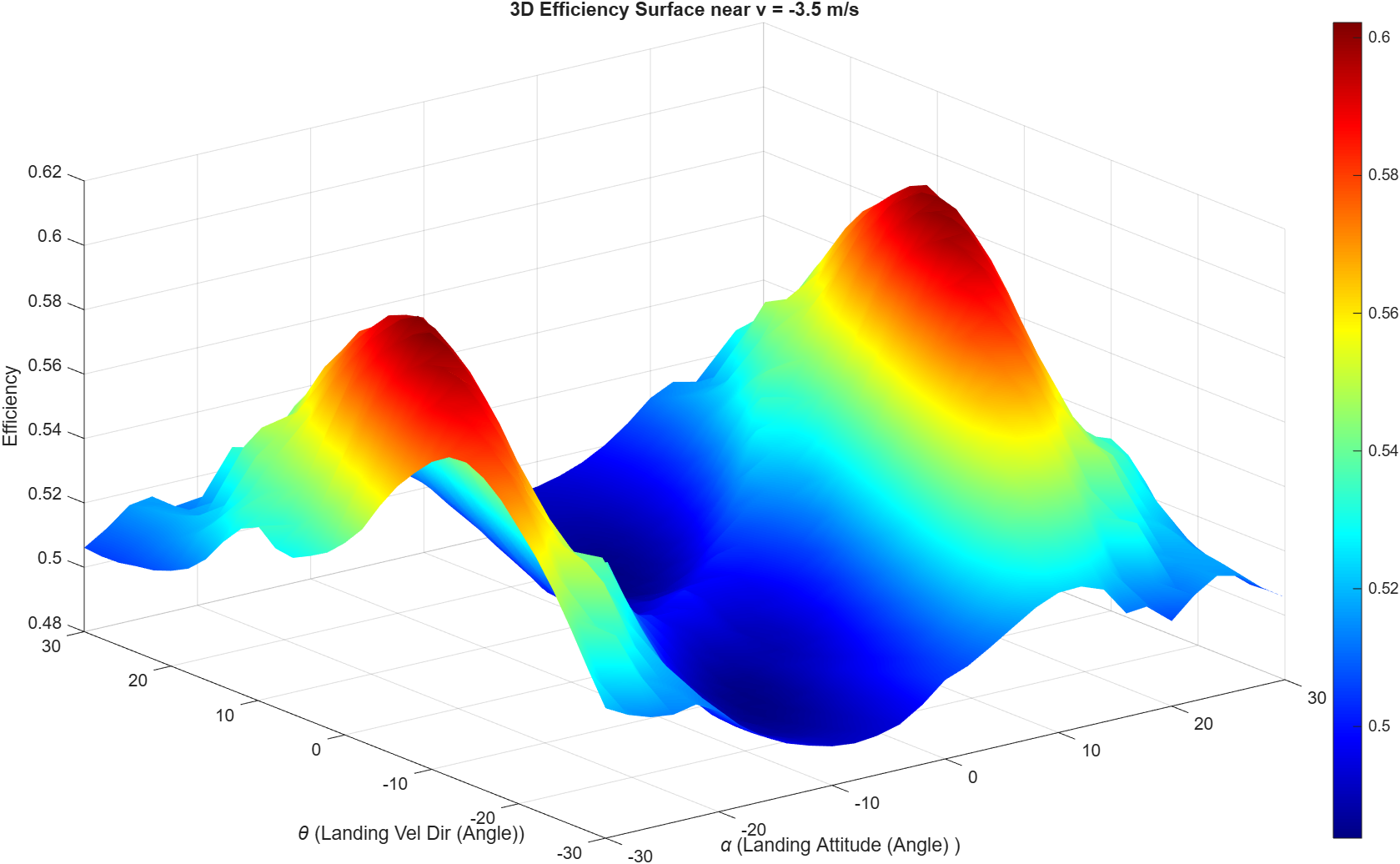
A wide sweep of landing velocity direction and landing attitude through the final conceptual design struture (following section on this page). This provides peaks of at which orientations the structure is most efficient.
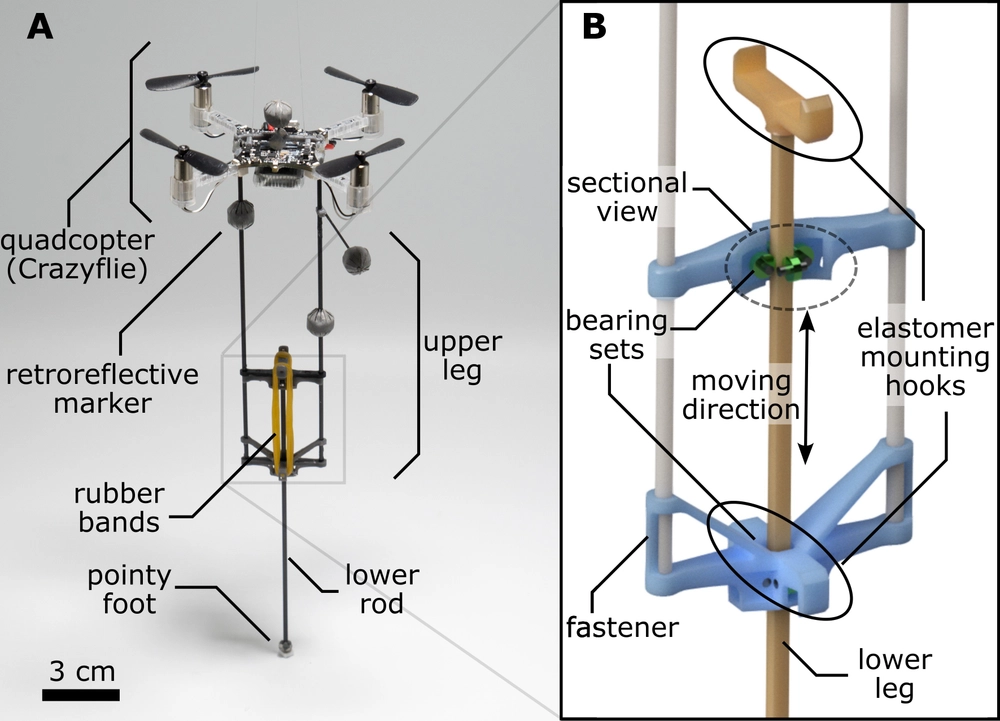
A bit of background on the hopcopter - a lightweight multimodal hopping robot that provides thrust through classic quadcopter drone rotors
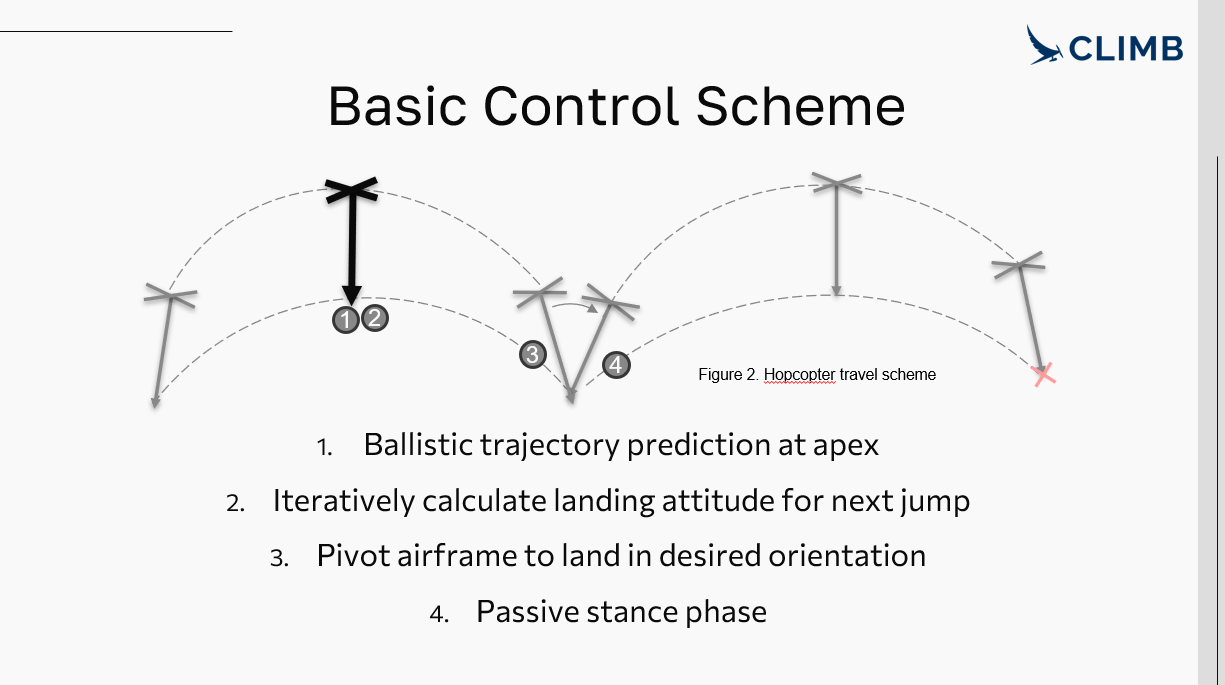
Basic control scheme of the classic Hopcopter. The aimed area of optimization was between 2 and 3.
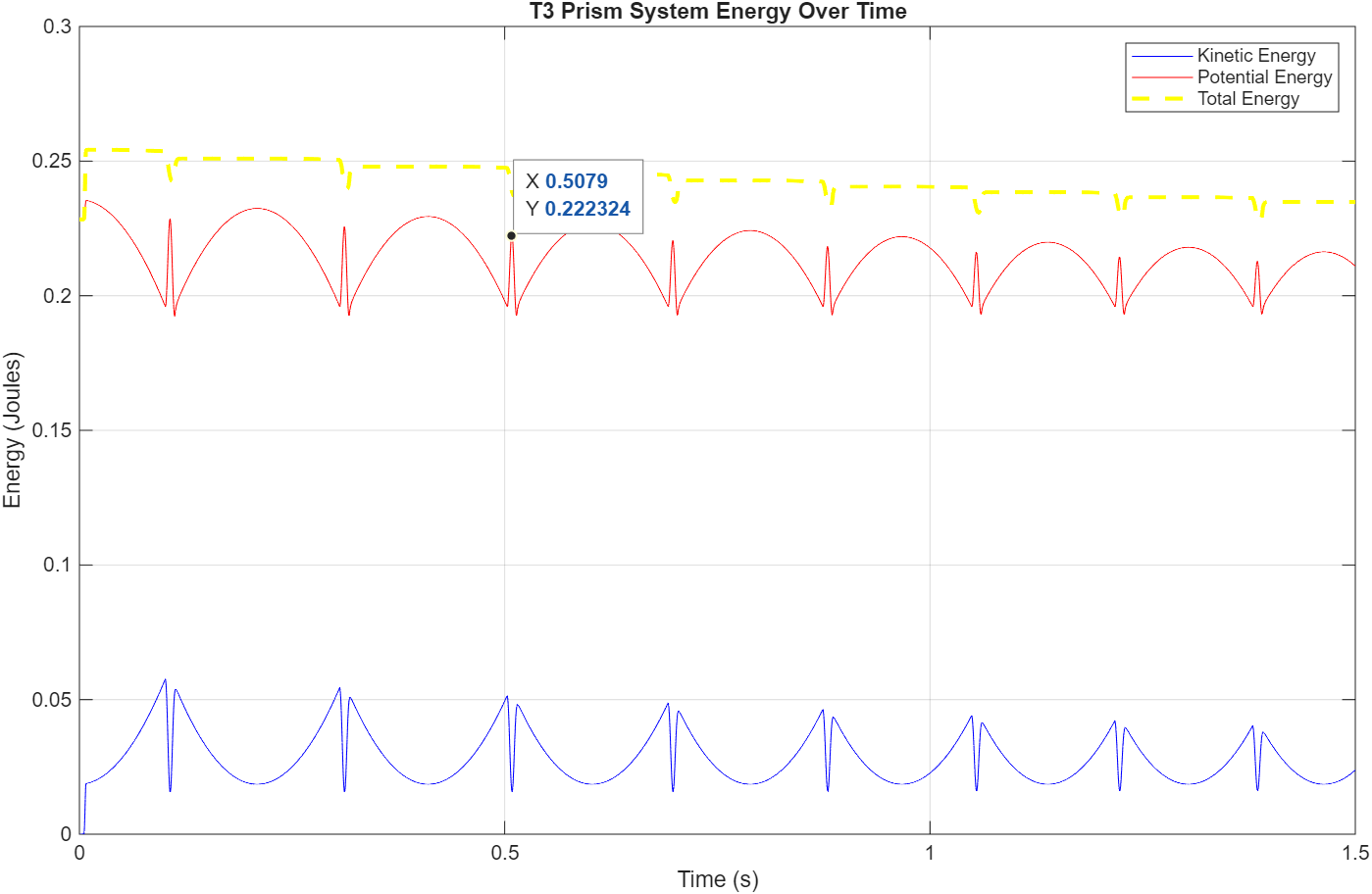
One of the many, many errors and bugs that came from this simulation. This specific one was due to incorrect energy tracking, not properly accounting for ground collision energy loss (ground being modelled as a 'stiff spring' means it retains energy). Solved through ignoring ground 'energy'.
Final Conceptual Design Build
The physical and conceptual design phase addressed the critical vulnerabilities of the initial 1-DOF telescoping leg, which suffered from bearing binding and required aggressive, energy-intensive airframe tilting to achieve desired landing attitudes. To resolve this, the design transitioned to a 3D Class-1 Tensegrity Wheel.
The final conceptual design enclosed the drone payload inside an 8+1 strut protective rolling cage designed to absorb multi-axis impact forces from any direction without collapsing. This completely decoupled the leg attitude from the main body, allowing the robot to survive and rebound from high-G landings on uneven terrain.
- Designed an 8+1 strut Class-1 tensegrity wheel configuration, isolating a central payload axle strut using elastic spokes within an 8-strut octagonal outer rim
- Balanced the strut count to maintain polygonal rolling efficiency while maximizing the internal cavity stroke length to prevent hard mechanical collisions between the central drone body and the outer rim struts
- Optimized the face-to-face twist angle of the octagonal prism to dramatically increase radial stiffness, ensuring lateral squeezing forces were converted into pure axial compression along the rigid carbon fiber struts
- Implemented a fully triangulated structural network by routing a 4th cross-shear diagonal Kevlar tendon across open facets
- Facilitated physical assembly of the notoriously complex tensegrity geometry by designing and utilizing a 3D printed PLA jig to hold struts in proper spatial alignment while the tendon network was strung
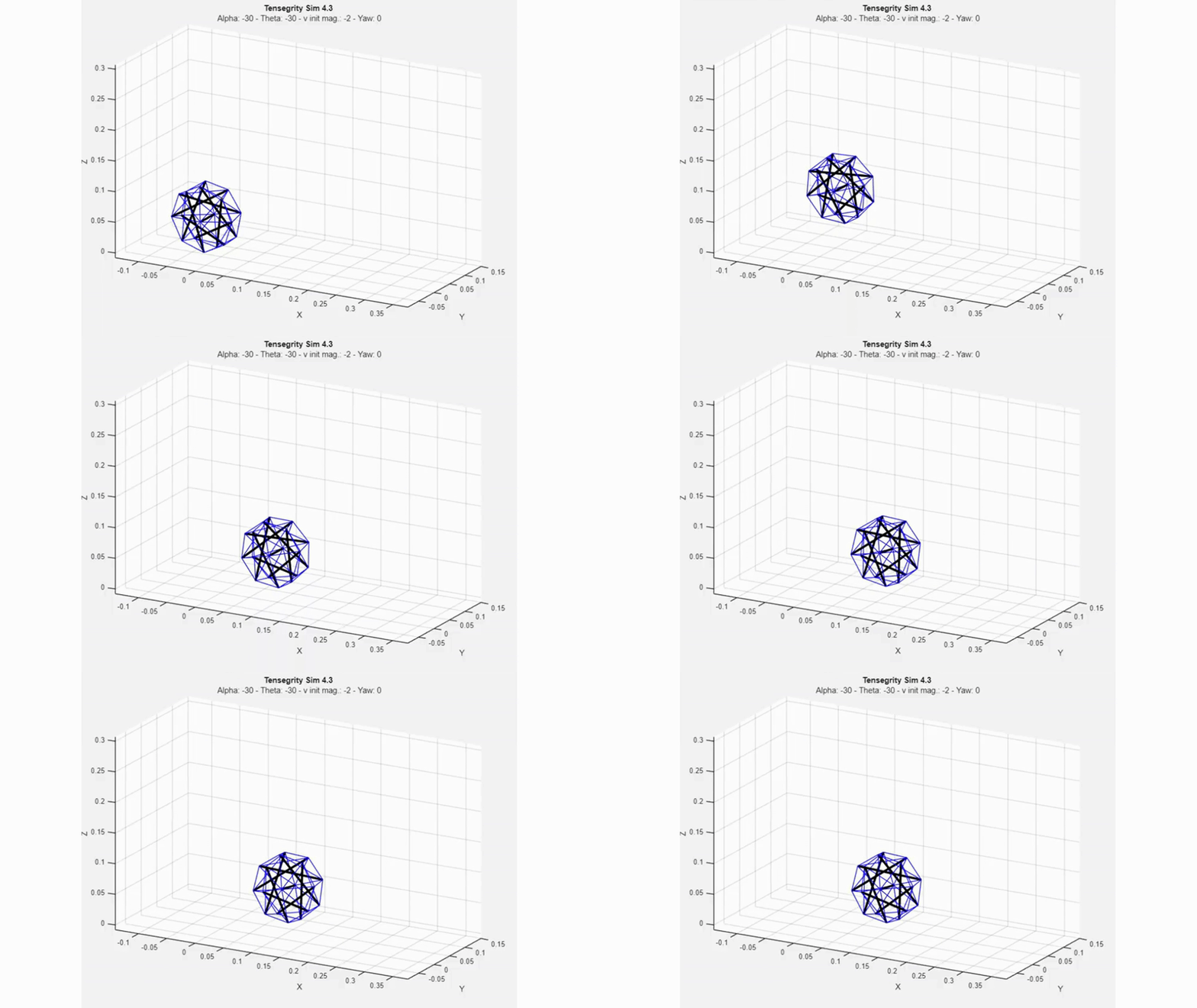
Final conceptual design simulation in a specific landing orientation, where both hopping and slight rolling ability is shown. Efficiency map shown in previous section.
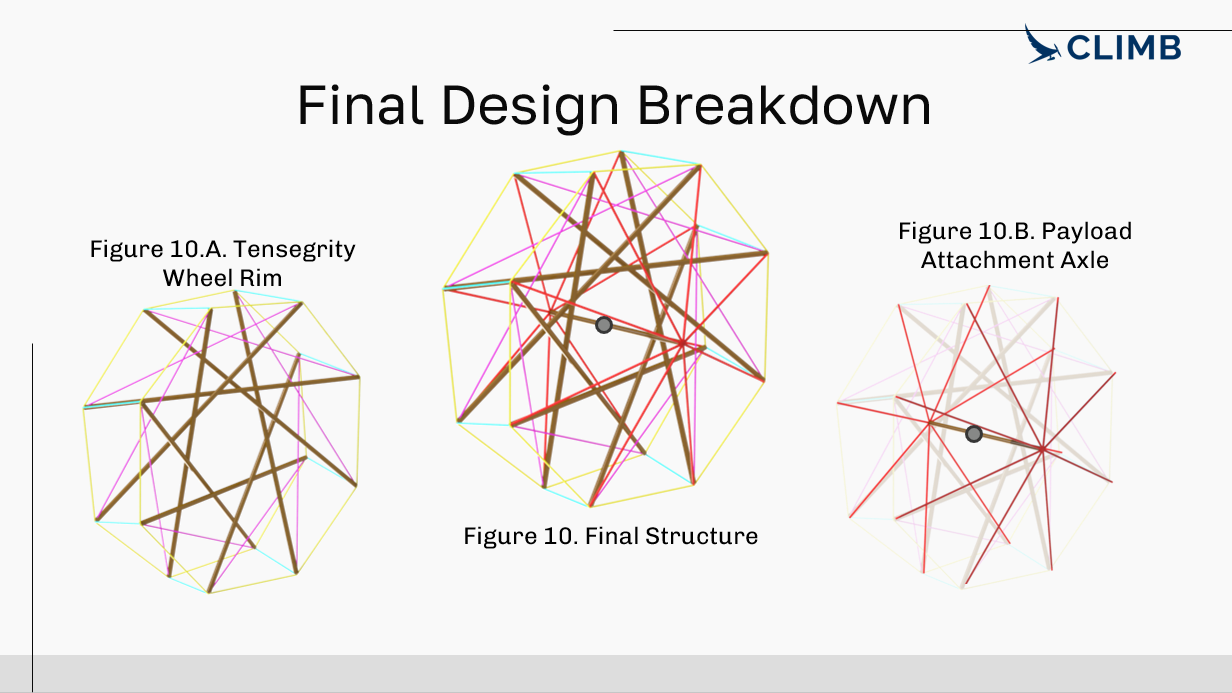
Breakdown of final desing. Outer rim is composed of stiff kevlar fibres, while central payload axis is attached through compliant elastomers to still facilitate hopping, while also allowing rolling.
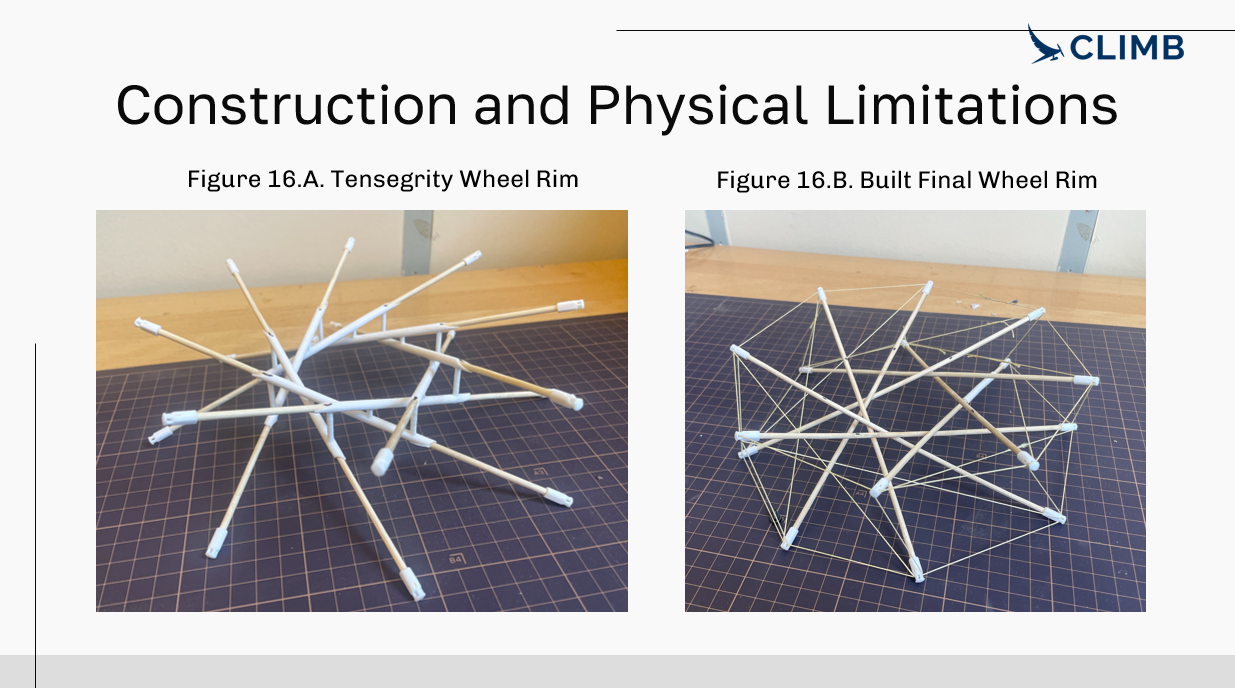
Physical construction of the tensegrity geometry proved difficult, requiring a specialized, single use, assembly fixture (PLA printed) to allow proper geometry alignment.
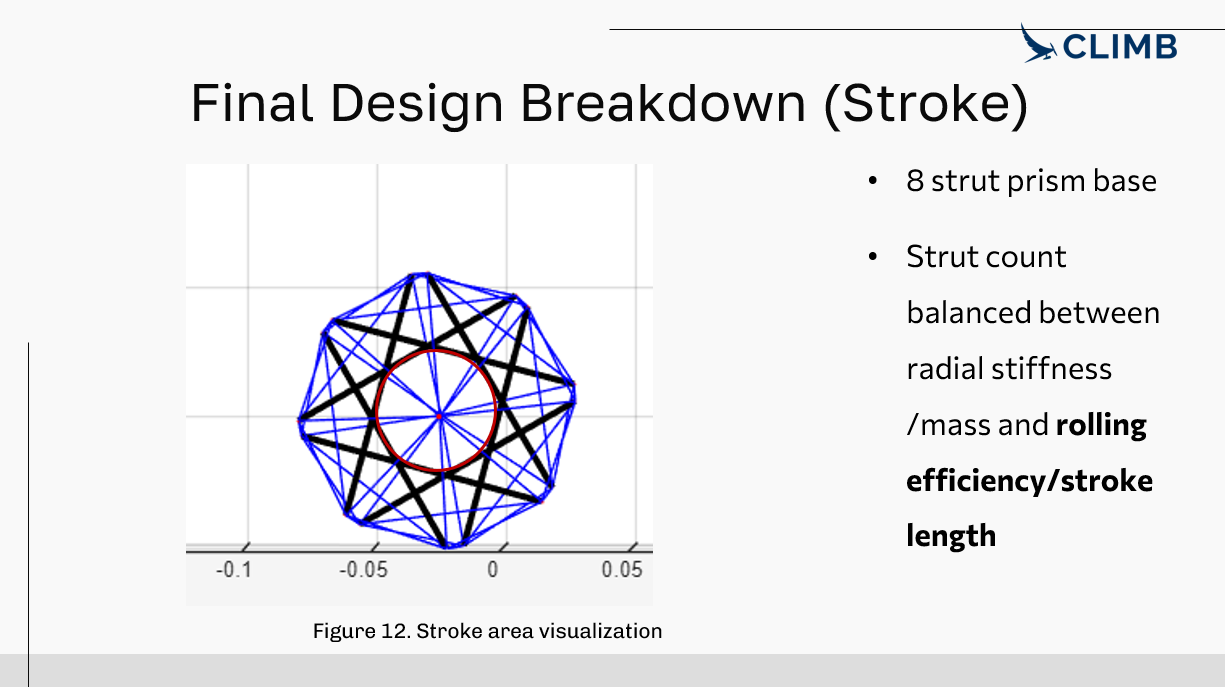
Consideration 1 - Stroke Length: Defines the maximum allowable travel distance for the central payload axle before it physically collides with the outer rim struts. This parameter is directly tied to the total strut count, which influences determines the shape and volume of the internal cavity.
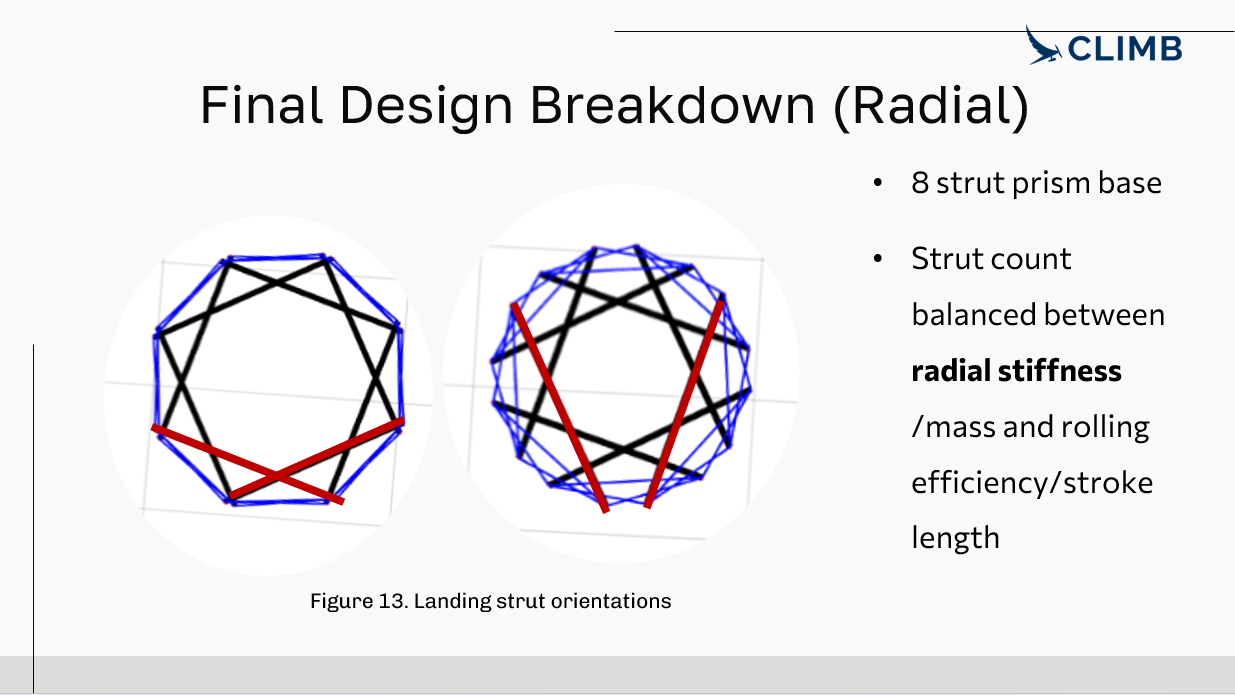
Consideration 2 - Radial Rigidity: Represents the wheel's ability to resist collapsing inward from lateral impacts. By increasing the face-to-face twist angle of the prism, the stiff struts align diagonally to intercept incoming radial forces, effectively converting bending loads into highly resistant pure axial compression, rather than just collapsing.
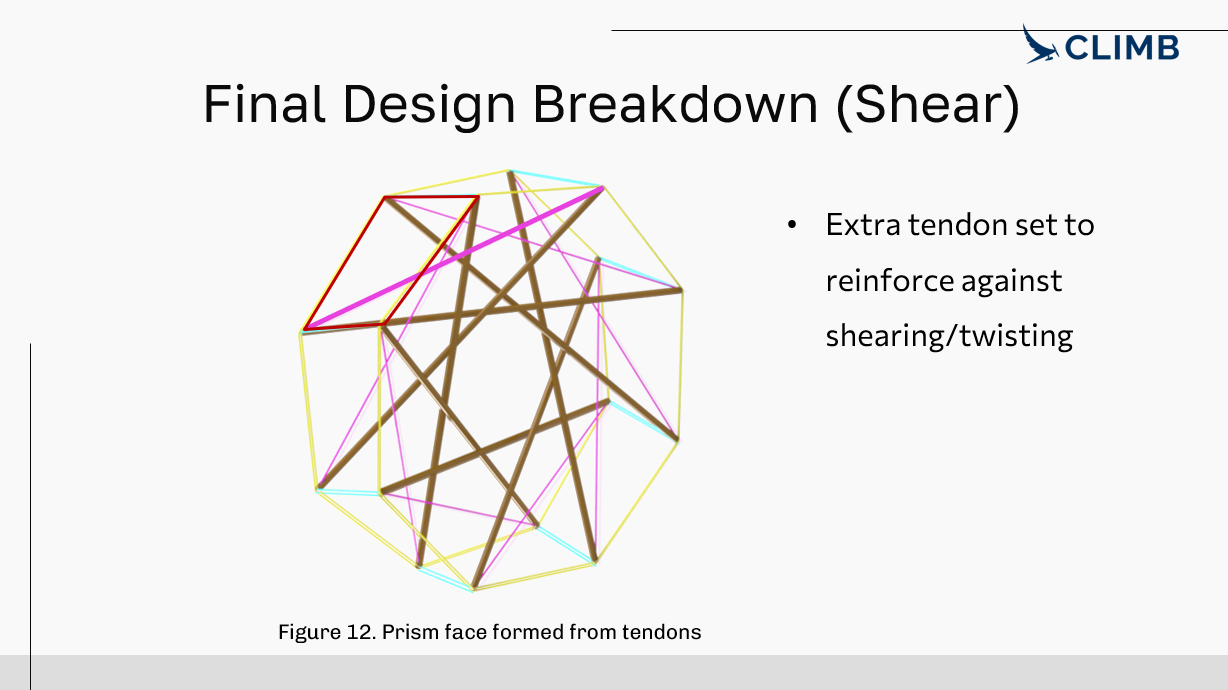
Consideration 3 - Cross-Shear Tendons: Solves the structural vulnerability of standard tensegrity prisms, which can easily twist and collapse under shear forces due to open, un-triangulated side facets. Adding a fourth diagonal Kevlar tendon across each panel fully triangulates the network, locking out this twisting mechanism and converting shear forces into pure axial tension.
Final Presentation (UnERD Podium)
As with any somewhat long lasting project, documentation of design choices and any issues that arise is incredibly important. Troubleshooting has taken up the majority of my time throughout this project, and being able to track why decision were made and how to solve common issues is an integral part of staying efficiently progressing.
Presentation (UnERD 2026) was on August 25th.
- Podium presentation of 10 minutes + 5 minutes questioning period