Jaden Zhang
UT27 - Formula SAE Racecar
University of Toronto Formula racing design team (UTFR)
Since its inception in 1997, the University of Toronto Formula Racing Team (UTFR) has undertaken the task of building a formula-style, open-wheel electric race car from scratch annually to compete in North American and European FSAE events. For the 2026-2027 season, the primary vehicle mandate is realizing a true 4wd system - overcoming the gearbox limitations of UT26 - while pushing the boundaries of mass reduction and front-end packaging efficiency.
As the Steering & Brakes Lead for UT27, responsibilities center on critical decision-making, team mentorship, and system-level architecture. Technical targets for this season include driving a rigorous subsystem mass reduction from 8.436kg to 6.766kg, and overhauling the brakes pedal tray with a reverse floor-mounted master and EBS cylinder layout to accomodate more efficient front chassis packaging. To achieve more accurate load applications for a new GD/DMLS steering column mount, a custom load assessment assembly is being integrated directly into the Driver-in-the-Loop (DiL) interface.
Beyond engineering design, I put a core focus is placed on cultivating the next generation of team members. This involves establishing structured knowledge transfer pipelines, with one of the major soft chages that I am applying being the individual clear documentation of every subsystem in Steering & Brakes.
Key Skills: Catia/3DExperience Environment, Solidworks components/assemblies, Ansys FEA, Fusion 360 Generative Design, knowledge transfer/documentation aggregation
Current UT27 Progress
July 2026 - Present
Throughout the summer of 2026, after the Formula Electric event at Michigan Internation Speedway, work on the 2026-2027 vehicle began. In addition to administrative duties as a section lead, some technical (and publically presentable) progress is displayed below.
In Collaboration with: Adalric Tai, Parker Pie, Rebecca Duarte, Brandon Chow, Tszhei Wong, David Li. Under UTFR.
- Mass and monetary budgets, assigned through free/fixed mass splits proportional to mass target (210kg), are distributed to subsystems based on UT26 and planned upgrades
- Sponsorships and outreach to renew and potentially open up new partnerships, totalling to more than $8000 CAD
- 3DX/CATIA file name and structure management of mutliple subsystem assemblies, and using publishing and Schemes/Latest Schemes file organization
- Singular week design, inventory, manufacturing and assembly of a simple steering column load assessment structure, with planned iterations to improve design effectiveness
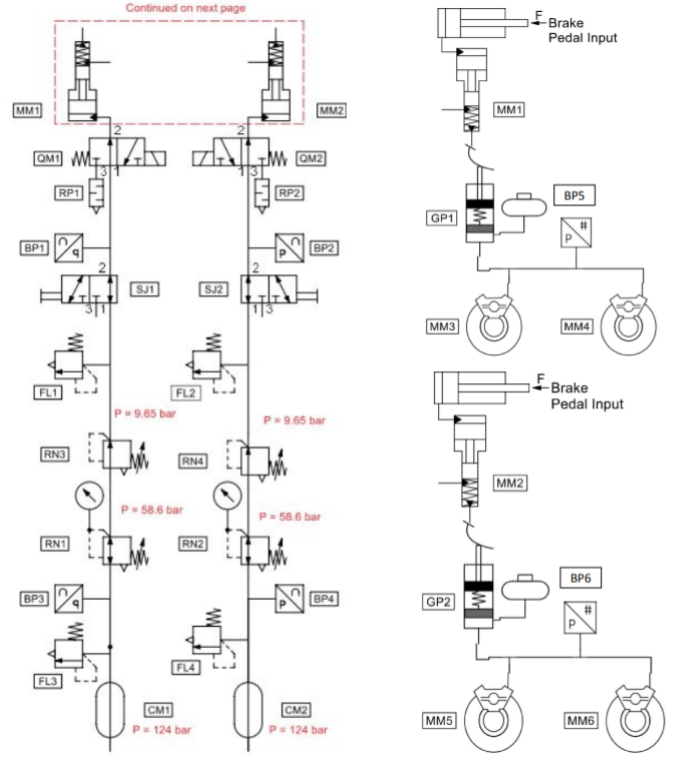
The planned hydraulic and pneumatic circuits of the brakes and Emergency Braking System (EBS), respectively. Specific components, such as fluid sensors, are still being finalized. General circuit based on UT26 design. Made with Bosch Scheme editor.
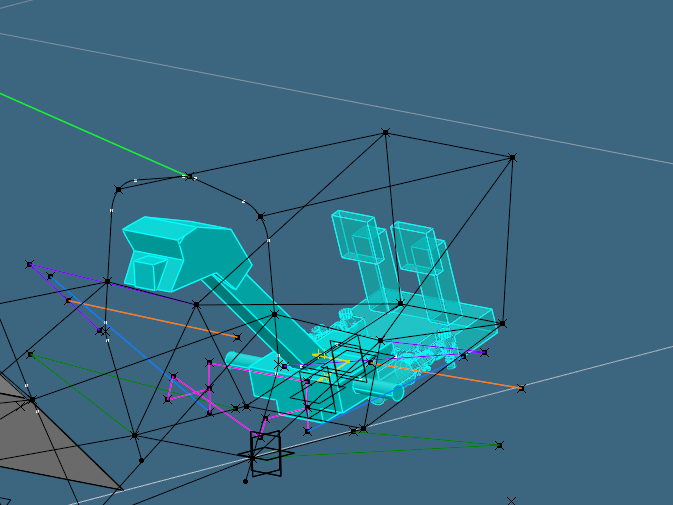
Preliminary spaceclaim in front chassis area - pictured, from left to right, are is the steering column mount, steering column, steering rack assembly, pneumatic Emergency Braking System air tanks, and the pedal tray. These approximate dimensions, used alongside other sections' equivalents, were used to finalize layout and general space claims.
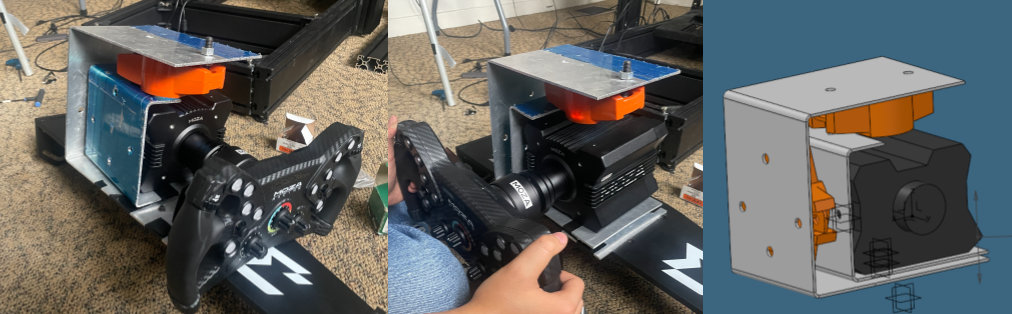
Cadding and first prototyping of a steering input load asssessment system. The main load cell used is a hanging scale that was already in inventory, being unused for anything. This project required a quick turnaround of about a week, from inception to a completed build. This specific build does not give our loads to a satisfactory extent, and will be iterated upon.
UT26 Vehicle Controls Design Binder
July 2025 - July 2026
As a part of my goals to streamline and document more design choices for effective knowledge transfer, a high level overview of the entire vehicle controls (brakes & steering) was consolidated into a 26 page design binder. Additionally, the documents acts as a hub that links to other relevant documentation for recruits and other section members, such as basics of brakes load transfer, and steering load calculations.
In collaboration with: Mo Taban, David Li under UTFR.
- Clear and technical language to formally document design choices and justification for effective future reference and knowledge transfer
- Simulated vehicle weight transfers as a function of braking force, with a fixed deceleration of 1.6g to model the ideal brake curve
- Used Python MatPlotLib to plot the weight transfer function as well as the actual braking line when using a dual master cylinder (front, rear) along with a balance bar and adjustable proportioning valve
- Utilized the brakes system spreadsheet to track constants and values to effectively troubleshoot modelling results